How to Have a Non-Religious Wedding Ceremony That Still Feels Meaningful
Planning a wedding without religious traditions can feel unclear at first. This guide walks through meaningful, non-religious ceremony ideas I often help couples explore—without pressure, scripts, or expectations.
In this guide:
What makes a non-religious ceremony feel meaningful
Ceremony structure options (with and without an officiant)
Personal elements guests actually connect with
Common concerns couples have (and how to handle them)
What this looks like in real weddings
A large majority of my couples want Jesus and the Church to have nothing to do with their wedding and their ceremony and their vows. If this is you, I support you.
I also support couples who do invite faith and spirituality into their big day — because my role as a planner is to support couples in making choices that are most meaningful to them.
No matter what.
As a wedding planner, I often see couples worry that a non-religious ceremony will feel impersonal—when in reality, the opposite is usually true.
What Makes a Non-REligious ceremony feel meaningful
A non-religious ceremony isn’t a blank slate — it’s a chance to design a moment that reflects your values, story, and shared vision of marriage. Every element can be chosen with intention rather than tradition.
You want your ceremony to strike three important tones: seriousness, sincerity, and expression.
Exchanging vows — committing to one person for life, sharing a home, building a family in its many forms and choosing intimacy — is serious business. Levity has it’s place, but this moment deserves care and attention.
Ways to bring sincerity and depth into your ceremony:
Live music, which increases endorphins and oxytocin, making social connection a more dynamic process.
Readings from your elders or loved ones, spoken narrative carries a strong emotional weight
Unity ceremony, where an intense shared focus can create feelings of trust and belonging
A moment of reflection, allowing yourselves to look out at the people gathered to witness your commitment — added bonus, deep breaths will calm your nervous system particularly if you aren’t keen on the spotlight
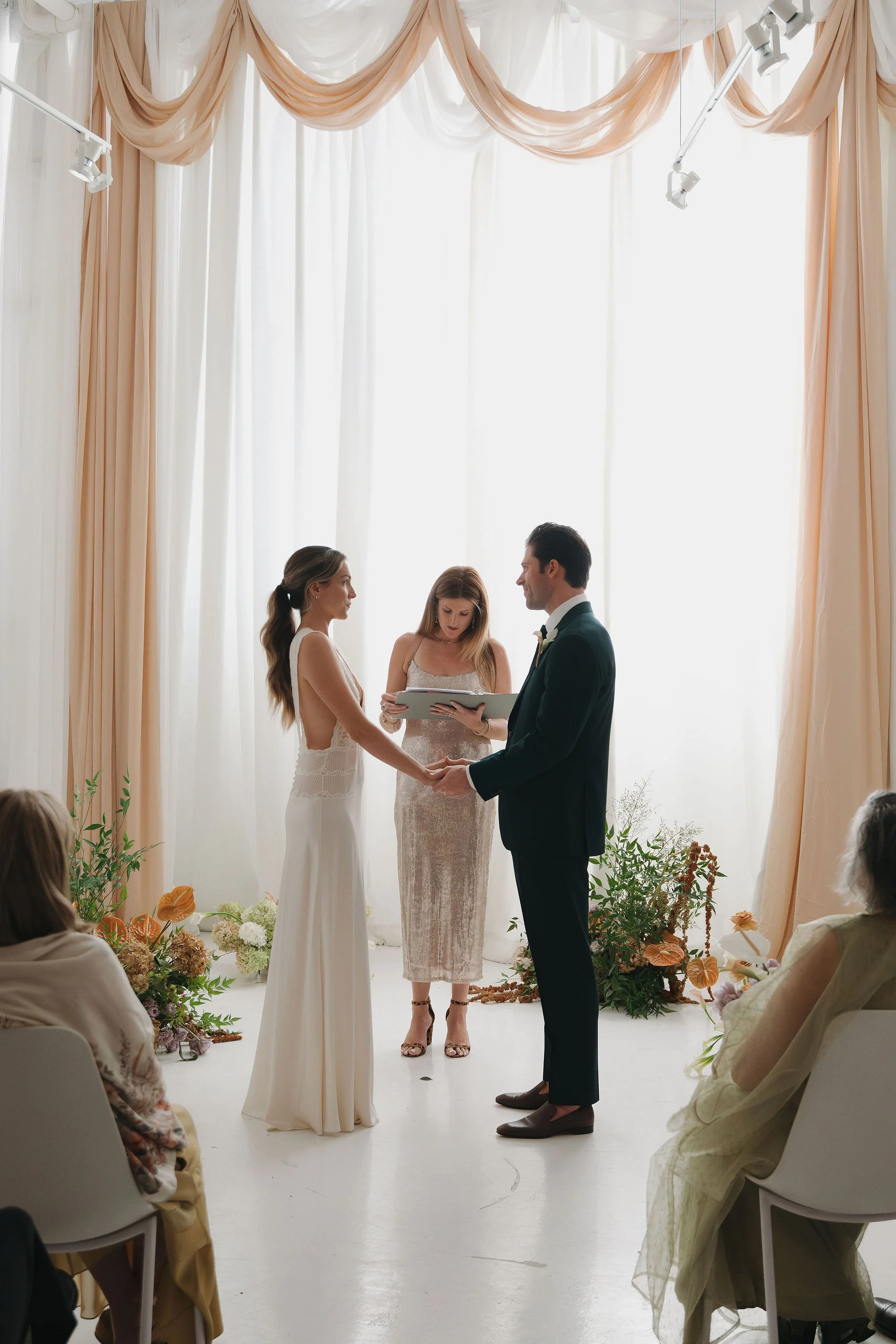
Photo by Jillian Blanc Photography
How to Structure a Ceremony Without Religious Traditions
A secular ceremony can still follow a familiar and comfortable flow: welcome, readings, vows, ring exchange, pronouncement, and recessional. Working with a professional can help prevent your ceremony from feeling redundant or flat.
Here’s what each section typically includes:
Opening
Your officiant(s) acts as the host — introducing themselves and their role in your lives, greeting your guests, and gently encouraging them to be present (yes, this is where phones get put away).
Processional
You and your wedding party enter and gather at a spot where you are all visible. This may include a stage, chairs, a chuppah/arch/arbor, flowers, microphones, etc. or it might not include any of the aforementioned performance enhancing items.
Welcome and Message
Your officiant acts as a conduit between you and your guests. Explaining who you are and why you are the best fit for each other, giving a reminder as to why marriage is so amazing, and perhaps some advice on how to do it well.
Readings and Unity ceremony
You may opt for both, one or the other, or neither. (NOTE: having neither will significantly reduce your ceremony length).
Exchange of vows and rings
In order for a ceremony to be legally binding you’ll need the declaration of intent (“Do you?” “I do.”) but you will likely also want to say vows, which can be repeat after me style (“I NAME promise to…”) or personally written. Most couples will also want to exchange rings. Work with your officiant to create a script that avoids feeling redundant and clunky.
Pronouncement/proclamation
This is the part where the officiant might say, “and now by the power vested in me… it is my honor to introduce…you may now kiss…” And then you kiss and then everyone cheers. Simplicity is often best here.
Recessional
Cue the music. Everybody is dismissed, or perhaps you opt to take a full-ceremony photo, or recess a little then create a receiving line for guests to repeat the same thing one after another in an elementary-school-inspired single-file line (“you look beautiful”, “that was so beautiful”, “this weather/venue/day/life is so beautiful”).
Planning a ceremony often brings up questions you didn’t expect. That’s normal — and it’s something we help couples navigate every season.
Personal elements guests actually connect with
Your ceremony can be completely unique because no two people like you are getting married. Think about how you show up as a couple, how you make each other feel, and why you’re choosing a life together.
Ways to express that:
Personally written vows — Check out The Lettery Studio for professional help.
Personalized readings — poems, lyrics, quotes
Music selections — meaningful songs chosen by you
Persons of honor — your wedding party, the officiant, flower girls/ring bearers, readers, and who processes down the aisle
Your ceremony location — which sets the tone straightaway
Common Concerns Couples Have About Non-Religious Ceremonies
Is a non-religious ceremony too short?
A 12-15 minute ceremony is often ideal.It allows time for grounding and meaning, while still keeping guests engaged. Exact length depends on processional size (how many people), readings and unity ceremonies (which includes transition times), and the overall flow you choose (like if your dog is ring bearer or you hide the rings under guests chairs for them to find and bring forth).
How can I honor family traditions?
By including them! Talk together about what traditions are most important to your family, which ones have meaning to you, and which ones you don’t mind including to appease the masses. Here are some ideas:
Have a chuppah or mandap as a nod to family heritage
Let your granny give a reading
Wear an heirloom just for the ceremony
Play an instrumental version of a meaningful song
Do we need an officiant?
You do not necessarily need an officiant. For Quaker ceremonies the couple might act as the host of the ceremony, letting guests stand and speak to fill the program.
If you are already legally married then you could script out something that feels more like a play, with the different speakers knowing their cues based on the timing and structure of your script. In any case, a day of coordinator is vital to ensure all the people in your ceremony have a director.
→ View Day-of coordination services
What this looks like in real weddings
Non-religious ceremonies look different for every couple, but the most meaningful ones share a common thread: intention. Here’s how couples have brought these ideas to life in real weddings.
Paris-Inspired Dinner Party Wedding for Anna & JT
In this celebration, the couple centered their ceremony around community and shared experience rather than formality. Instead of a traditional rite, they opened with a toast-like welcome that invited guests into their story, followed by personalized vows and intentional music selections that echoed themes of joy and connection. If you’re curious how an experience-focused ceremony can weave seamlessly into a reception, this wedding is a great example.
→ See the full wedding here
Intentional Vows Read from a Vintage Children’s Book at Laura & Will’s Wedding
For Laura and Will, the non-religious ceremony was less about length and more about meaningful words. Their processional set the tone with a semi-rehearsed musical piece, that hit just right, synchronizing the words of the song to when Laura walked down the aisle. Rather than relying on religious language, they used a children’s book and read each page back and forth, making it both humorous and heartfelt.
→ Explore their wedding here
Hope & Chris: A Bold and Bright Ceremony Full of Expression
Hope and Chris embraced a colorful, expressive ceremony that celebrated who they are as individuals and as a couple. Instead of defaulting to traditional readings, they chose passages and songs that spoke to their unique values — from literature that had shaped their relationship, to chosen family members offering toasts in place of scripted readings. This is a great example of how a secular ceremony becomes memorable and intentional through personal expression.
→ View their full celebration
Want More Examples?
If you’d like to browse more non-religious weddings that brought unique ideas to life, visit our Real Weddings portfolio or explore additional planning guides that can help you build your vision step by step.
If you’re planning a non-religious ceremony and want support bringing everything together calmly and intentionally, day-of coordination can help ensure your vision is honored without adding stress.